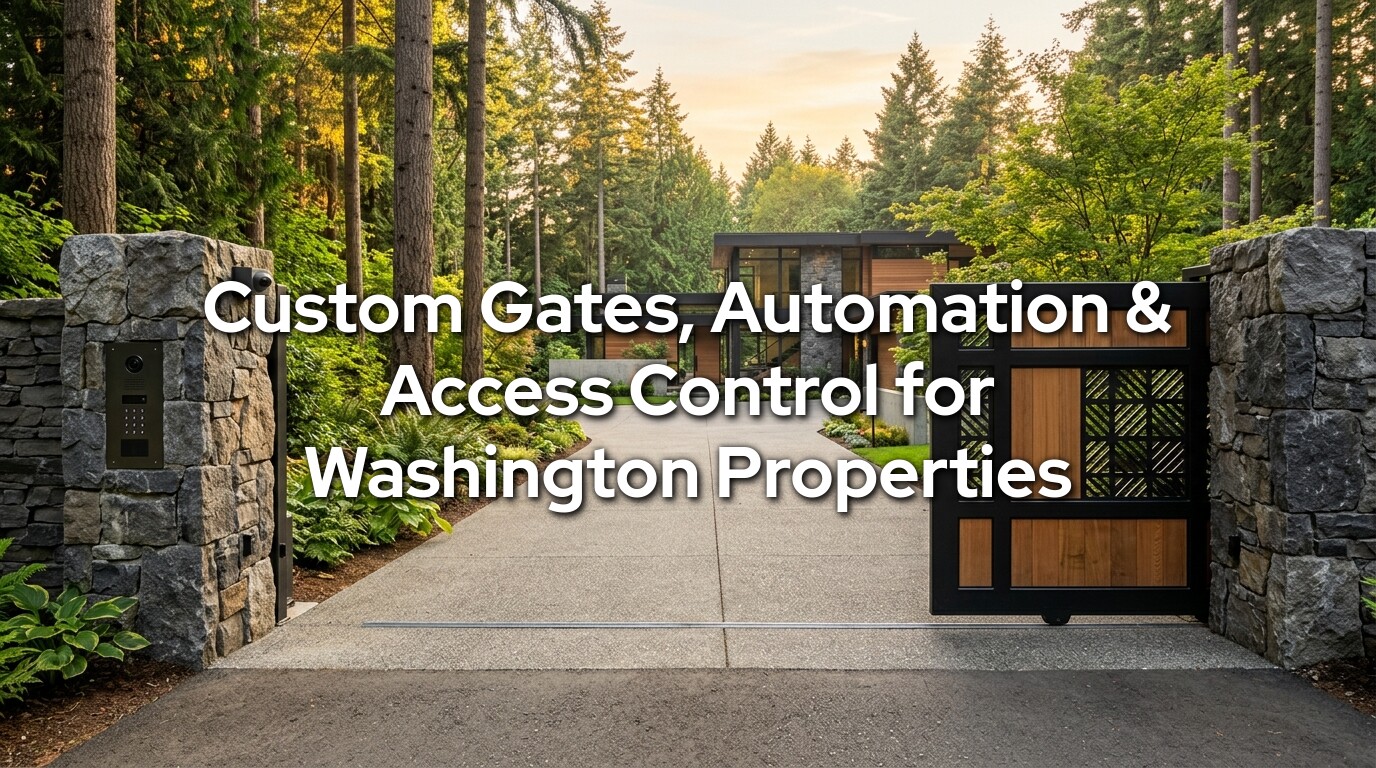
Custom Gates & Access Control in WA should be planned as one connected entry system, not as a decorative gate with electronics added later. The gate structure, operator, safety devices, access controls, power supply, drainage, emergency access, and long-term service plan all affect one another. A weakness in any one of those areas can make an otherwise attractive entrance unreliable, difficult to maintain, or unsafe.
Washington property owners also face conditions that generic gate packages do not always handle well. Persistent rain affects foundations, electrical enclosures, tracks, and exposed hardware. Wet or disturbed soil can move posts. Fir needles and leaf litter interfere with photo eyes and sliding gate tracks. Solid privacy panels catch wind. Coastal salt air attacks unprotected metal. Rural properties may require long electrical runs or carefully sized solar power. Winter outages make battery backup and manual release procedures more than optional conveniences.
Emerald Gate Systems approaches these projects from its own fabrication shop in Sedro-Woolley, Washington. The same accountable team handles design, CAD planning, welding, installation, automation, access control, and service. Work is not handed from a gate fabricator to an unrelated automation installer and then to a third service company. That matters because the person sizing the hinges, posts, operator, electrical load, and safety devices needs to understand the complete system.
This guide explains how custom gates, automatic gate operators, access control, safety equipment, site preparation, permits, maintenance, and Washington weather fit together. It is written for homeowners, farms, HOAs, property managers, commercial facilities, and public-facing properties that need a durable entrance rather than a short-term equipment package.
What Does Custom Gates & Access Control in WA Mean for a Property Owner?
Custom gates and access control in Washington combine a purpose-built moving gate with the equipment that decides who may enter, how the gate moves, and how people and vehicles are protected. The result may include a fabricated gate, operator, safety sensors, keypad, intercom, credential reader, vehicle detector, camera, battery backup, and emergency access hardware.
The word custom should describe more than appearance. A properly customized gate is designed for the opening width, driveway slope, available runback, expected traffic, wind exposure, vehicle types, soil conditions, security goals, and architectural setting. A twelve-foot residential driveway on level ground is a different engineering problem from a commercial yard that receives delivery trucks throughout the day.
Access control is the decision-making layer. It may be as simple as a keypad for a private driveway or as detailed as a managed system with individual credentials, time schedules, video verification, visitor entry, audit history, and separate permissions for residents, vendors, staff, and emergency responders.
At a driveway entrance, a camera that reads the plate is one more way to make that decision. For what it does well, how Northwest Washington rain and dark winters affect it and what to settle on privacy first, see how LPR gate access works in practice.
Automation is the movement layer. The operator must be matched to the gate’s weight, length, balance, duty cycle, travel resistance, and exposure. A powerful operator cannot correct a gate that drags, flexes, binds, or places excessive load on its hinges. Mechanical problems should be solved mechanically before more motor power is added.
Safety is a separate design responsibility. A moving gate can create entrapment, crushing, drawing-in, and impact hazards. Photo eyes, monitored edges, physical guarding, controls, warning signs, proper spacing, and compliant gate construction must be planned together. A remote control alone does not make an automatic gate system complete.
Why Choose a Family-Owned Gate Company in Sedro-Woolley?
A family-owned gate company in Sedro-Woolley can provide direct regional accountability without sending every project through a distant sales office. Emerald Gate Systems is headquartered in Skagit County, operates its own fabrication shop, and serves nearby properties through one team responsible for design, welding, installation, automation, access control, and future service.
Location affects practical service. A company based in the region is already familiar with Skagit Valley soil, exposed properties near the coast, long rural driveways, agricultural equipment access, winter storm outages, and ferry logistics for island work. Those are not special exceptions here. They are normal project conditions.
In-house fabrication also changes what can be corrected before installation. Post locations, hinge geometry, frame stiffness, infill spacing, operator brackets, conduit paths, and attachment points can be coordinated during design instead of improvised after a prefabricated gate arrives. Hand-forged wrought iron, laser-cut steel, Western Red Cedar, and stone details can be incorporated without separating design intent from structural responsibility.
The trade-off is that true custom work requires planning. It may take longer than ordering a stock panel, and the design should be finalized before steel is cut or cedar is fitted. That added planning is useful when the goal is a gate that fits the property, moves correctly, accepts automation cleanly, and can be serviced years later.
Review Emerald Gate Systems’ gate, automation, access control, and entry services to see how the complete system can be kept under one accountable team.
How Does One Team Take a Gate From Design Through Service?
A one-team gate project moves through site evaluation, design, fabrication, infrastructure, installation, automation, access control setup, safety testing, documentation, and service planning without dividing responsibility among unrelated contractors. This reduces gaps between the gate structure, operator requirements, electrical work, safety devices, and the way the owner expects to use the entrance.
The process normally starts on the property. Photos and rough measurements are useful for an early conversation, but they do not reveal every condition that affects a gate. The installer needs to see the grade, drainage, road approach, shoulder width, underground utility concerns, fence alignment, vehicle turning path, wind exposure, and available space for a swing or sliding gate.
After the site is understood, the gate can be drawn around actual dimensions. CAD planning helps coordinate the opening, frame, infill, posts, hinges, operator attachment, access pedestal, vehicle detection, and conduit. Decorative details are important, but the first questions should be structural: Will the gate remain square? Is the frame stiff enough? Can water leave the site? Can the operator move the gate without fighting gravity or binding hardware?
Fabrication follows the approved design. Because Emerald Gate Systems fabricates in Sedro-Woolley, the gate and its automation provisions can be built as one system. Brackets, reinforcement, wire paths, hardware clearances, and service access do not have to be added as afterthoughts in the field.
Installation then combines the structural and control work. Posts and foundations must support the gate under its own weight and under wind load. The operator must be mounted and adjusted. Safety devices must cover the actual hazard areas. Access controls must match the people, vehicles, and schedules on the property. Finally, the system should be tested through normal use, obstruction conditions, power loss, and manual release.
The owner should receive more than a working remote. A useful handoff explains who has access, how credentials are changed, what happens during an outage, how the manual release works, what should be inspected, and whom to call when the behavior changes.
Automatic Gate Installation Washington State Property Owners Can Plan Around
Automatic Gate Installation Washington State projects require more than selecting an operator from a catalog. The installer must match the gate configuration, traffic level, safety devices, power source, foundations, drainage, controls, emergency access, and local approval requirements to the property. Washington rain, soil movement, wind, outages, and rural distances must be considered before equipment is ordered.
A complete automatic gate system usually includes the moving gate, support structure, operator, control board, monitored entrapment protection, access devices, power supply, disconnect or manual release provisions, and site infrastructure. Some systems also use battery backup, solar charging, vehicle loops, wireless communication, video intercoms, cameras, or networked credential management.
New construction provides the cleanest opportunity to coordinate conduit, drainage, foundations, and road layout. Existing properties can still be automated, but retrofits require an honest evaluation of the gate. A manual gate that sags, drags, twists, or has weak posts should not be automated until the mechanical problems are corrected.
Field observation: gates that move acceptably by hand in dry August weather may behave differently after months of rain. Soil can soften, tracks collect debris, hinges corrode, and timber components absorb moisture. The installation should be judged for the worst normal season, not only for the weather present on installation day.
Electrical work may require a permit through Washington Labor and Industries or through a city that operates its own electrical inspection program. The correct authority depends on the project location. Fire apparatus access and emergency entry requirements may also require review by the local fire authority.
For an Automatic Gate Installation Washington State site review, call Emerald Gate Systems at (360) 657-9975. The consultation can identify the right configuration before fabrication, trenching, or equipment selection begins.
Which Gate Configuration Fits the Property?
The correct configuration depends on available space, grade, opening width, wind exposure, traffic, and maintenance tolerance. Swing gates work well where there is clear arc space. Sliding gates preserve driveway depth but need side room. Cantilever gates avoid a ground track but require a longer structure and substantial support foundations.
When is a swing gate the right choice?
A swing gate is usually a strong choice for residential, farm, and lower-cycle entrances with adequate room for the leaf to open without blocking the road or striking vehicles. It offers clean appearance and relatively simple mechanical movement, but it performs poorly on steep grades, tight approaches, or sites exposed to heavy wind.
A single swing leaf requires a wide clear arc and places substantial load on one hinge post. A paired gate divides the opening into two leaves, reducing each leaf’s length and swing radius, but it adds a second operator or coordinated drive system. Stops, hinges, center alignment, and wind behavior require careful adjustment.
Solid cedar or steel privacy panels can make a swing gate act like a sail. On exposed sites near Anacortes, Whidbey Island, Camano Island, or open farmland, the frame, posts, hinges, operator, and foundations must be sized for that added force. Open picket or ornamental designs reduce wind pressure but provide less visual privacy.
For the island side of wind loading, outage exposure and ferry logistics, see our guide to gate wind load and outage planning on Whidbey Island.
When is a sliding gate better?
A sliding gate is often better where vehicles need to stop close to the entrance, the driveway slopes across the opening, or the site cannot spare a swing arc. It moves parallel to the fence, but it needs sufficient side runback and careful protection against debris, pinch areas, and changing ground conditions.
A tracked sliding gate runs on wheels over a ground-mounted track. The arrangement can be compact, but the track must remain straight, supported, and clear. Gravel, mud, ice, fir needles, and small stones can interfere with travel. Drainage and cleaning access matter as much as the operator.
A cantilever gate hangs above the roadway and rolls through support assemblies located beside the opening. It avoids a ground track, which is helpful for uneven pavement, snow, gravel, and frequent truck traffic. The trade-off is a longer gate frame, larger counterbalance section, heavier support structure, and more demanding foundation work.
What about pedestrian and mixed-use entrances?
Pedestrians should not be expected to walk through an automated vehicle gate unless the complete system is specifically designed for that use. A separate pedestrian gate gives people a more predictable route and allows accessible hardware, controlled entry, and closing behavior to be designed without exposing users to vehicle-gate movement.
Commercial and multi-family properties often benefit from separating resident traffic, visitor entry, service access, deliveries, and pedestrian movement. The initial installation may be more involved, but separate lanes and access points reduce conflicts and make permission management clearer.
How Should Gate Materials Be Chosen for Pacific Northwest Conditions?
Gate material should be selected for structure, corrosion exposure, wind, maintenance, appearance, and repairability. Steel offers strength and fabrication flexibility. Wrought iron supports detailed ornamental work. Aluminum reduces corrosion and weight. Western Red Cedar provides warmth and privacy but requires movement allowance and finish maintenance in Washington moisture.
| Material | Best suited for | Main strengths | Important limitations | Maintenance focus |
|---|---|---|---|---|
| Fabricated steel | Custom driveway, commercial, farm, and security gates | High strength, weldable, repairable, supports large custom frames | Needs complete corrosion protection, heavier than aluminum | Inspect coatings, weld areas, drains, fasteners, and damaged finish |
| Wrought iron details | Ornamental entrances and traditional architecture | Detailed shaping, durable visual character, compatible with steel frames | Labor intensive and vulnerable where protective finish is damaged | Watch joints, decorative pockets, and low areas where moisture remains |
| Aluminum | Coastal properties and weight-sensitive designs | Lower weight and strong corrosion resistance | Different stiffness and repair considerations than steel | Inspect finish, fasteners, dissimilar-metal contact, and hardware wear |
| Western Red Cedar | Residential privacy gates and Northwest architectural designs | Warm appearance, renewable visual character, effective screening | Moves with moisture, adds wind area, requires finish care | Maintain sealant, replace damaged boards, preserve drainage and airflow |
| Stone elements | Columns, monuments, and integrated entrance structures | Strong visual permanence and architectural weight | Requires engineered support and careful coordination with moving hardware | Inspect cracking, settlement, drainage, caps, and gate clearances |
Steel is often the most flexible structural choice because it can be cut, reinforced, welded, and repaired. The finish system matters. Water should not be trapped inside frames or decorative pockets, and damaged coating should be addressed before corrosion spreads under the finish.
Aluminum is useful near salt air and where reducing moving weight benefits the operator and hardware. It is not simply lightweight steel. Frame proportions, joints, fasteners, and attachment methods must suit the material. Contact between dissimilar metals also deserves attention in a wet or coastal environment.
Cedar works well when the owner wants privacy or a material that belongs naturally with Northwest homes. The frame must allow for wood movement, drainage, replacement, and airflow. A completely solid infill increases wind load, so privacy goals should be balanced against the site’s exposure.
Field observation: the lowest board or panel edge often reveals whether the design considered Washington weather. If the material sits where splashback, mud, wet vegetation, or trapped debris remain against it, deterioration starts at the bottom even when the rest of the gate looks new.
Explore Emerald Gate Systems’ custom gate design and in-house fabrication options when material, wind exposure, and architectural fit need to be solved together.
What Does an Access Control System Actually Do?
An access control system verifies a person, vehicle, credential, or schedule before signaling the gate or door to open. It may use keypads, cards, fobs, mobile credentials, video intercoms, telephone entry, vehicle identification, or managed databases. Good access control also defines what happens when credentials expire, networks fail, or power is lost.
The access device does not move the gate by itself. It sends an authorized command to the gate controller. The controller then checks operating conditions and activates the operator. Safety devices continue to protect the movement zone regardless of whether the open command came from a remote, keypad, intercom, vehicle detector, or management platform.
Residential systems may need only a small number of users and straightforward visitor access. Commercial and community systems often need individual records, time schedules, temporary credentials, event history, multiple entrances, and different permissions for staff, vendors, residents, property managers, and emergency services.
The best system is not necessarily the one with the most features. Each added device creates another power, communication, administration, and service requirement. A homeowner who needs reliable family entry may be better served by a simple keypad and video intercom than by a complex platform that no one wants to manage.
Network-connected access control should be treated as part of the property’s technology environment. Default passwords, outdated firmware, shared administrator accounts, unrestricted remote access, and forgotten user credentials create avoidable risk. The system should have a clear owner responsible for user changes, backups, updates, and vendor access.
Which Credentials Fit a Home, Business, Farm, or Community?
The right credential depends on who enters, how often permissions change, whether identity must be verified, and how much administration the owner can support. Keypads are simple but codes can be shared. Cards and fobs identify individual users. Mobile credentials reduce physical tokens. Video intercoms help staff evaluate visitors before granting entry.
Are keypads enough for a private driveway?
A keypad is often sufficient for a private driveway with a small, stable user group. It is familiar, affordable to administer, and easy to combine with remotes. The main limitation is that shared codes do not prove who entered, and codes can continue circulating after vendors, tenants, or workers no longer need access.
Use separate temporary or scheduled codes where the system allows it. Avoid one permanent code shared among family, cleaners, contractors, delivery drivers, and guests. The convenience of one code becomes a security problem when no one knows who still has it.
When do cards, fobs, or mobile credentials make sense?
Individual credentials make sense when managers need to add and remove users without changing access for everyone else. They are especially useful for HOAs, apartments, commercial properties, and staffed facilities. Their value depends on consistent administration, because inactive users and lost credentials must actually be removed from the system.
Mobile credentials can reduce the cost and delay of issuing physical tokens, but they introduce phone compatibility, connectivity, app support, and user-training questions. A property should maintain a practical fallback for people whose phone is lost, discharged, replaced, or unable to connect.
What does a video intercom add?
A video intercom allows a resident, receptionist, security desk, or property manager to see and speak with a visitor before opening the gate. It improves decision-making for deliveries and guests, but image quality, night lighting, network reliability, mounting height, weather protection, and remote-call behavior must be tested at the actual entrance.
A camera is not useful if glare hides faces, rain covers the lens, headlights overwhelm the image, or the unit is mounted too far from the driver’s stopping position. The pedestal location should work for the vehicles expected on the property, not only for a standard passenger car.
How should commercial access be managed?
Commercial access should separate user roles, provide a documented method for adding and removing credentials, and preserve access during planned and unplanned outages. Managers should know who owns the administrator account, who reviews event history, who authorizes vendor changes, and how access is restored after a controller or network failure.
For internet-connected controls, use unique administrator accounts, strong authentication where available, controlled remote support, and a defined update process. Broader cybersecurity guidance is available through CISA cybersecurity best practices.
Learn more about access control systems for gates and entries, including keypads, credentials, video intercoms, cameras, and managed access.
How Do Washington Site Conditions Change Gate Design?
Washington site conditions change foundation design, drainage, material protection, wind planning, power choices, and maintenance frequency. Wet soil can move posts, debris can obstruct sensors and tracks, solid gates can catch coastal wind, salt air accelerates corrosion, and winter outages can disable systems that were designed without adequate backup or manual access.
What does persistent rain do to a gate system?
Rain is not usually a problem because water touches the gate. Problems develop where water remains. Poor drainage softens soil around foundations, fills track areas, carries debris into moving parts, reaches poorly protected wiring, and creates corrosion at joints, fasteners, frame openings, and damaged finish.
Enclosures should be selected and installed for their environment, but enclosure ratings do not excuse poor cable entry or drainage. Conduit can carry water. Underground boxes can fill. A connection placed at the lowest wet point may fail even if every component looked appropriate on paper.
Why do wet and shifting soils matter?
A gate can be perfectly fabricated and still become unreliable if its posts move. Wet fill, disturbed shoulders, organic soil, and slopes require careful foundation planning. The gate’s leverage is significant, especially with long swing leaves, cantilever structures, heavy privacy infill, or operators that repeatedly load the same attachment points.
Settlement may appear as a dragging bottom edge, changing latch alignment, uneven center gap, operator strain, or repeated limit adjustments. Reprogramming the operator is not a lasting repair when the structure beneath it is moving.
How should wind load be handled?
Wind load must be considered whenever the gate has substantial solid surface area. Cedar privacy boards, plate steel, closely spaced infill, signage, and decorative panels increase force on frames, posts, hinges, rollers, operators, and foundations. The problem is most visible during storms, but fatigue develops through repeated smaller wind events.
Open designs reduce wind load. Where privacy is required, the team may adjust frame stiffness, post size, hinge capacity, operator selection, opening direction, or infill spacing. There is no universal hardware upgrade that turns every solid gate into a safe exposed-site gate.
What changes near salt water?
Coastal properties need material and finish choices that anticipate salt exposure. Aluminum, stainless hardware where appropriate, protected steel, isolated dissimilar metals, drainage, and regular rinsing or inspection can extend service life. Salt deposits collect in joints and sheltered areas, so visible front surfaces are not the only places to inspect.
What happens in snow, ice, and winter outages?
Snow and ice affect clearances, tracks, photo eyes, hinges, and vehicle detection. Battery backup can preserve limited operation, but capacity depends on battery condition, temperature, gate resistance, accessory loads, and traffic. Every owner should know the manual release procedure before a storm, not discover it during an outage.
Field observation: battery backup is sometimes treated as unlimited emergency power. It is not. A gate that cycles repeatedly for residents, employees, or deliveries can exhaust backup capacity quickly, especially when cold batteries also support intercoms, heaters, lights, radios, and network equipment.
What Should Happen During an On-Site Gate Evaluation?
An on-site gate evaluation should document the opening, grade, drainage, vehicle movement, gate travel, soil, utilities, power, communication, safety zones, emergency access, wind exposure, and user needs. It should end with a clear recommendation that explains why a swing, slide, cantilever, manual, automatic, solar, or utility-powered system fits the property.
- Define the purpose. Clarify whether the priority is privacy, controlled entry, livestock management, traffic control, commercial security, curb appeal, or a combination.
- Measure the usable opening. Record the actual clear width, shoulders, fence line, road edge, grades, and available space for gate travel.
- Map vehicle movement. Check turning radius, stacking distance, delivery vehicles, trailers, emergency apparatus, and where drivers will stop to use access devices.
- Evaluate soil and drainage. Identify fill, soft ground, slopes, standing water, culverts, ditches, track drainage, and locations where foundations can be supported.
- Review power options. Compare utility trenching, existing electrical capacity, voltage drop over long runs, battery backup, and honestly sized solar power.
- Plan access control. List users, guests, vendors, deliveries, employees, residents, managers, and emergency responders, then define how each group enters.
- Identify hazards. Locate entrapment zones, public reach-through areas, pedestrian routes, fencing gaps, pinch points, road conflicts, and areas requiring photo eyes or monitored edges.
- Confirm approvals. Determine whether electrical permits, city review, fire district approval, HOA design review, utility coordination, or property-line verification may be needed.
- Plan maintenance access. Leave room to reach operators, batteries, control boards, rollers, hinges, chain, release hardware, and underground connections after landscaping is complete.
- Document the recommendation. Explain the configuration, materials, controls, safety devices, exclusions, owner responsibilities, and next design steps.
A good evaluation may rule out an idea the owner initially preferred. A swing gate may not fit the slope. A tracked slider may be a poor choice where gravel and needles collect. Solar may not be reliable under dense fir cover. A solid privacy gate may create excessive wind load. Honest constraints are part of a useful consultation.
Schedule a free on-site consultation to review drainage, foundations, gate travel, power, and access needs before the entrance design is finalized.
What Permits, Inspections, and Standards Apply to Automatic Gates?
Automatic gate projects may involve electrical permits, local building requirements, fire apparatus access, HOA review, and recognized gate safety standards. The exact approvals depend on jurisdiction and property use. Washington Labor and Industries handles many electrical permits, while certain cities operate their own electrical inspection programs.
Permit responsibility should be discussed before work begins. Property owners should not assume that low-voltage controls, solar systems, or existing circuits automatically eliminate inspection requirements. The authority having jurisdiction decides what is required for that location and scope.
When is Washington L&I involved?
Washington Labor and Industries administers electrical permitting and inspections in many areas of the state. Some cities have their own electrical inspection authority. The project address determines where the permit belongs, so the installer or electrical contractor should verify jurisdiction rather than relying on a general county assumption.
Official information is available through the Washington L&I electrical permit and inspection portal. Property owners can also use the Washington L&I contractor lookup when confirming contractor status.
What does the fire district review?
Fire authorities may review clear width, gate opening operation, emergency access method, setbacks, turnarounds, and the effect of a gate on apparatus access. Requirements differ by jurisdiction and property. Approval should be sought early when the gate controls the only access route to a home, commercial building, community, or rural site.
A gate can be wide enough for a passenger vehicle and still create difficulty for emergency apparatus because of approach angle, roadside ditches, columns, landscaping, or inadequate space beyond the gate. The access route must be considered as a complete path.
What is UL 325?
UL 325 is a safety standard applied to door, gate, drapery, louver, and window operators and systems. For automated vehicular gates, it addresses operator classification, controls, entrapment protection, and related safety functions. The operator and external protection devices must be selected and installed as a coordinated monitored system.
Property owners can review the UL gate operator safety overview. Compliance is not created by placing a UL-listed operator on a gate whose construction, spacing, guarding, or safety-device layout is unsuitable.
What is ASTM F2200?
ASTM F2200 addresses the construction of automated vehicular gates. It covers physical gate features intended to reduce hazards, including openings, protrusions, fall protection, guards, and other construction details. It works alongside operator safety requirements rather than replacing them.
The current referenced standard page is available from ASTM F2200. A gate that was originally built for manual use may need structural and guarding changes before it is appropriate for automation.
Where do ADA requirements apply?
ADA requirements may apply to accessible pedestrian entries, door operators, controls, keypads, call stations, and routes serving public accommodations or other covered facilities. Operable parts should be within accessible reach and usable without tight grasping, pinching, or twisting. The complete route and door operation matter, not only the push button.
The official reference is the 2010 ADA Standards for Accessible Design. Emerald Gate Systems provides inspection-ready ADA documentation for applicable entry work, but the project team should still confirm the requirements for the specific facility and jurisdiction.
How Do Safety Devices Prevent Entrapment and Impact?
Gate safety devices monitor areas where a moving gate could strike, crush, draw in, or trap a person or vehicle. Common devices include monitored photo eyes and sensing edges. Their placement must match the actual gate movement and hazard zones, and the operator must respond correctly when each device is activated or disconnected.
A photo eye creates a monitored beam between a transmitter and receiver or uses a reflective arrangement. When the beam is interrupted, the controller changes or prevents gate movement according to the programmed function. Alignment, mounting stability, sunlight, vegetation, mud, snow, and lens contamination can affect performance.
A sensing edge responds when physical pressure is applied to a protected edge. Edges are useful where a person or object could contact a leading, trailing, or other hazardous surface that cannot be fully protected by photo eyes alone. They require suitable mounting, monitored connection, and routine physical testing.
Safety design also includes the gate itself. Openings that permit reach-through access to moving hardware, unguarded rollers, exposed pinch points, protrusions, weak guides, inadequate stops, and unstable gate structures cannot be corrected by adding one more sensor.
Vehicle loops and exit probes are useful control devices, but they should not be confused with complete entrapment protection. A loop may detect a vehicle in a defined area, while photo eyes and edges protect different hazards. Each device has a specific purpose.
Users must also understand that bypassing a failed safety device is not an acceptable long-term repair. If the gate stops operating because a monitored device is misaligned, damaged, or disconnected, the safe response is diagnosis and correction. Reprogramming the operator to ignore the problem removes a layer of protection.
Speak with an installation expert at (360) 657-9975 about operator classification, ASTM gate construction, monitored photo eyes, sensing edges, and emergency access before automating an existing gate.
What Does a Complete Custom Gate System Cost?
A complete gate system is priced according to gate size, material, fabrication detail, configuration, foundations, site access, power, trenching, drainage, operator duty, safety equipment, access control, permits, communication, and travel logistics. A reliable quote requires a site visit because two openings of the same width can require very different infrastructure.
The provided company source material includes one verified labor price: Emerald Gate Systems services all brands, including gates installed by others, at a transparent repair labor rate of $100 per hour. It does not provide verified universal installation price ranges. This page therefore does not invent low, average, or premium installation numbers that may mislead Washington property owners.
A useful proposal should separate the major cost drivers so the owner understands what is included. At minimum, the scope should address:
- Gate design, CAD work, material, finish, and fabrication.
- Posts, foundations, tracks, rollers, hinges, guides, stops, and structural hardware.
- Operator, control board, drive hardware, and required mounting components.
- Photo eyes, monitored edges, guards, warning signs, and other safety provisions.
- Access controls such as keypads, intercoms, fobs, mobile credentials, or cameras.
- Electrical power, conduit, trenching, communication cable, solar, and battery backup.
- Drainage, paving repairs, fence transitions, columns, and site restoration.
- Permits, inspections, fire access coordination, and required documentation.
- Programming, testing, user setup, training, and initial credential administration.
- Travel, ferry scheduling, remote-site logistics, and equipment access.
Why are custom gates more expensive than stock panels?
Custom gates include design, structural coordination, fabrication labor, finish preparation, site-specific hardware, and integration with automation. A stock panel may cost less initially, but field modifications, weak frames, mismatched posts, and poor operator attachment can erase the savings. The right comparison is complete installed performance, not the panel price alone.
Where can a project be simplified responsibly?
Costs can sometimes be reduced by simplifying ornament, choosing an open infill, using a single access method, avoiding unnecessary network features, planning conduit before paving, or selecting a configuration suited to the site. Safety devices, structural support, drainage, and required approvals should not be treated as optional upgrades.
Why does a long rural power run matter?
A long power run adds trenching, conduit, conductor, voltage-drop planning, restoration, and permit considerations. Rocky ground, paved drives, wetlands, ditches, and utility conflicts can make infrastructure more expensive than expected. Solar may be a strong alternative, but only where winter sun, shade, battery capacity, and actual cycle demand support it.
How Long Does Design, Fabrication, and Installation Take?
A custom automatic gate commonly requires several stages rather than one installation appointment. Site evaluation and design come first, followed by approvals, fabrication, site preparation, electrical work, installation, programming, safety testing, and user handoff. Straightforward projects move faster, while custom detailing, permits, utility work, and island logistics extend the schedule.
As a general planning framework rather than a promised company schedule, owners should think in weeks, not days. Initial evaluation and design may take one to three weeks. Custom fabrication may require several additional weeks. Permitting, special materials, electrical scheduling, concrete cure time, finish work, or access-control coordination can add time.
Physical gate installation may occur over a small number of working days after the infrastructure is ready, but that does not mean the entire project is a two-day job. Foundation work may need to precede the gate. Electrical inspections may occur on a different date. Final controls and safety testing should happen after the mechanical system is aligned and stable.
Weather can change the sequence. Excavation in saturated soil, coating conditions, concrete work, paving restoration, ferry cancellations, and winter daylight all affect productivity. A realistic schedule includes those possibilities instead of assuming every phase will occur under dry summer conditions.
Owners can help by making decisions early. Finalize gate style, finish, access devices, user groups, power route, communication method, columns, lighting, and landscaping interfaces before fabrication. Late design changes can affect the gate frame, posts, operator, conduit, and control equipment at the same time.
Request an itemized gate project quote after the site evaluation so fabrication, infrastructure, access control, safety equipment, and scheduling are visible in one scope.
What Maintenance and Repair Should Gate Owners Expect?
Automatic gates need recurring inspection because they combine a moving structure, operator, safety devices, controls, weather exposure, and electrical equipment. Owners should watch for changes in sound, speed, alignment, stopping behavior, sensor reliability, corrosion, loose hardware, drainage, and battery condition rather than waiting for a complete failure.
A light-use residential gate and a high-cycle commercial entrance should not share the same service interval. As a practical planning range, many residential systems benefit from professional inspection every six to twelve months. High-traffic, coastal, agricultural, or debris-heavy sites may need quarterly or semiannual attention.
Owners can perform basic observations without opening electrical enclosures or defeating controls. Keep the travel area clear. Remove leaves, needles, gravel, mud, and snow. Clean accessible photo-eye lenses. Watch for insects or vegetation around devices. Confirm that signs and guards remain in place. Report unusual movement before repeated operation causes more damage.
Professional maintenance may include:
- Checking gate alignment, level, clearances, stops, and structural movement.
- Inspecting hinges, rollers, chains, belts, racks, bearings, guides, and brackets.
- Testing photo eyes, sensing edges, controls, limits, reversal behavior, and manual release.
- Reviewing batteries, charging performance, solar output, terminals, and enclosure condition.
- Inspecting wiring, conduit entries, grounding, water intrusion, and pest damage.
- Checking access devices, credentials, intercom operation, cameras, and network connection.
- Looking for coating damage, corrosion, cedar movement, trapped moisture, and loose infill.
- Documenting conditions that should be corrected before they become emergency failures.
Field observation: fir needles cause more service trouble than many owners expect. They collect in tracks, cover drainage openings, block photo-eye paths, hold moisture against hardware, and hide small stones that lift a sliding gate wheel. A few minutes of seasonal cleaning can prevent a larger mechanical problem.
Emerald Gate Systems services all brands, including systems the company did not install. The transparent repair labor rate is $100 per hour. Parts, travel, specialty equipment, and project-specific work should be confirmed in the service scope.
What Wears Out During Long-Term Gate Ownership?
Gate systems wear through cycles, weather, corrosion, vibration, battery aging, mechanical resistance, and changing site conditions. Batteries, rollers, hinges, chains, belts, wheels, seals, contactors, relays, control boards, transmitters, keypads, and communication devices all have finite service lives. Replacement timing depends more on use and environment than calendar age alone.
How long do batteries usually last?
Backup and solar batteries often require replacement before the operator itself. A general planning range is roughly three to five years, but deep discharge, cold weather, heat inside enclosures, poor charging, high accessory load, and repeated outages can shorten that period. Battery testing should include capacity, not only resting voltage.
How long can an operator last?
A correctly selected operator on a well-built, freely moving gate may serve for many years. Ten to twenty years is a reasonable planning range for quality equipment under suitable conditions, but it is not a warranty. Excessive cycles, poor balance, water intrusion, impact, undersizing, weak power, and neglected mechanical resistance shorten life.
When do rollers, hinges, and bearings need replacement?
Mechanical hardware may last from several years to well over a decade depending on load, material, lubrication requirements, contamination, alignment, and exposure. Replacement should be based on play, noise, corrosion, binding, flat spots, damaged surfaces, and changing gate geometry rather than waiting for complete seizure.
What happens to control boards and electronics?
Electronics can fail from age, power events, moisture, insects, corrosion, heat, vibration, or obsolete communication technology. Surge protection and correct enclosure practices reduce risk but do not make boards permanent. Owners should preserve model information, wiring documentation, credential records, and administrator access before a failure occurs.
How should owners plan for renewal costs?
Long-term ownership should include a maintenance budget and a reserve for batteries, mechanical wear parts, access devices, and eventual operator replacement. It is usually less expensive to replace a worn roller, hinge, chain, or battery during scheduled service than to repair secondary damage after the gate binds or the operator is overloaded.
Book a gate repair and maintenance inspection when movement, noise, alignment, battery performance, or safety-device behavior begins to change.
Where Does Emerald Gate Systems Install and Service Gates?
Emerald Gate Systems is based in Sedro-Woolley and serves Skagit, Whatcom, and Snohomish counties, Whidbey Island, Camano Island, the San Juan Islands, and the greater Puget Sound region. The strongest service fit is within Northwest Washington, where the team can apply local fabrication, site knowledge, and ongoing service support. Island County — Oak Harbor and the rest of Whidbey Island — is part of the regular service territory; the design and material requirements there differ from the mainland enough that we put them in a dedicated guide on custom gates for Oak Harbor and Whidbey Island.
What types of projects are common in Skagit County?
Skagit County projects include residential driveway gates, farm and agricultural entrances, custom fabricated gates, commercial access points, gate automation, access control, repair, and maintenance. Sedro-Woolley, Mount Vernon, Burlington, and Anacortes each present different property conditions, from working acreage to I-5 commercial traffic and coastal exposure.
Being headquartered in Sedro-Woolley reduces the distance between the fabrication shop and projects in the company’s home territory. That makes site checks, fabrication adjustments, installation coordination, and later service more direct than working through a company commuting from Seattle.
How do Whatcom County projects differ?
Whatcom County includes city properties in Bellingham, agricultural land near Lynden and Ferndale, rural driveways, commercial facilities, and border-area traffic. Systems may require farm-friendly openings, controlled commercial access, video intercoms, winter power planning, or service arrangements suited to properties outside dense urban areas.
What matters in Snohomish County?
Snohomish County includes dense residential and commercial areas around Everett, Marysville, Lynnwood, Bothell, and Edmonds, along with acreage and foothill properties near Arlington, Granite Falls, Darrington, Monroe, Sultan, Gold Bar, and Index. The gate configuration should reflect the actual traffic, road approach, weather, and service distance.
Commercial and multi-family sites may need higher-cycle operators, managed credentials, visitor entry, vehicle detection, and documented maintenance. Rural properties may place more emphasis on solar, battery backup, wide equipment access, snow clearance, and long power runs.
What changes for island projects?
Island projects require planning for salt exposure, ferry schedules, material transport, remote diagnostics, power availability, and service access. Completing as much fabrication and system preparation as possible before travel reduces field uncertainty. Spare components and clear documentation become more valuable where an unscheduled return trip is difficult.
Whidbey and Camano properties may combine coastal exposure with long driveways and limited utility access. San Juan projects may require more detailed staging and remote-management planning. Solar can be useful, but tree shade and short winter daylight must be evaluated honestly.
Custom Gates & Access Control in WA should still be organized around real service coverage rather than a generic statewide claim. A local page is strongest when it explains how the company’s actual location, fabrication capabilities, travel patterns, and service territory affect project delivery.
What Common Gate Myths and Buying Mistakes Should Owners Avoid?
The most common gate mistakes come from treating the operator as the whole system, choosing a design before evaluating the site, ignoring safety and drainage, underestimating wind, sharing one access code, assuming solar always works, or waiting for complete failure before service. Most of these problems are less expensive to prevent than correct.
Myth: A stronger motor fixes a heavy or dragging gate
A larger operator does not correct weak posts, poor hinges, damaged rollers, bad alignment, excessive wind area, or a gate that drags. More force may hide the problem temporarily while increasing stress on the frame, hardware, operator bracket, and safety system.
Myth: Any manual gate can be automated
Some manual gates can be retrofitted, but they must first be evaluated for construction, stability, spacing, support, movement, guarding, and operator attachment. A gate built only to be moved occasionally by hand may need substantial structural and safety changes before automation.
Myth: One photo eye makes the gate safe
Safety devices must cover the actual entrapment zones and match the operator’s monitored requirements. A single device may protect one path while leaving other hazards unaddressed. Gate construction, guarding, device placement, programming, and testing all contribute to safety.
Myth: Solar power works anywhere in Western Washington
Solar gate automation can work well, but panel exposure, winter production, tree shade, traffic, battery capacity, accessory loads, and maintenance determine reliability. A system sized from summer sun conditions may fail during short, dark January days.
Myth: A shared keypad code is access control
A shared code controls the gate but provides little individual accountability. Once the code is given to guests, vendors, contractors, former tenants, and delivery drivers, the owner may not know who still has it. Individual or temporary credentials are better where permissions change frequently.
Myth: Maintenance can wait until the gate stops
Gate systems often show warning signs before failure: slower travel, changing gaps, new noise, repeated sensor faults, battery alarms, water in enclosures, loose hardware, or intermittent access devices. Early inspection can prevent secondary damage and reduce emergency downtime.
Contact Emerald Gate Systems at (360) 657-9975 to discuss an existing gate, a new custom entrance, access control, automation, or a site condition that does not fit a standard package.
Frequently Asked Questions About Custom Gates and Access Control in Washington
How much does a custom automatic gate cost in Washington?
A custom automatic gate is priced according to the opening, material, fabrication, foundations, operator, safety equipment, access control, power, drainage, permits, and site logistics. Emerald Gate Systems does not use one universal installation price. The company provides free on-site consultations and itemized project quotes based on actual property conditions.
Two driveways with the same width may require very different work. One may have level ground and nearby power, while another needs deep foundations, long trenching, solar, a cantilever gate, extensive drainage, or ferry transportation. Compare complete installed scopes rather than a gate-panel price or operator price by itself.
Does Emerald Gate Systems offer free estimates?
Emerald Gate Systems offers free on-site consultations for gate, automation, access control, ADA entry, and related projects. The visit allows the team to measure the opening, review drainage and grade, identify power and communication options, discuss gate movement, and prepare a scope based on the property instead of a generic package.
Owners should prepare a short list of priorities before the visit. Note who will use the entrance, what vehicles need access, whether privacy matters, where guests and deliveries will stop, and what happens during an outage. Photos and inspiration images are helpful, but the site conditions control the final recommendation.
How long does custom gate installation take?
A custom gate project usually takes several weeks from site evaluation through design, fabrication, infrastructure, installation, programming, and testing. Simple projects can move faster, while permits, special materials, electrical work, finish schedules, concrete cure time, custom access control, weather, or island logistics can extend the timeline.
The gate may be physically installed over a few working days after the posts, foundations, conduit, and power are ready. That installation window should not be confused with the complete project schedule. Final timing should be confirmed in the written proposal after the design and site conditions are known.
Do I need a permit for an automatic driveway gate in Washington?
An automatic gate may require an electrical permit, and some properties also need local building, fire access, right-of-way, or HOA approval. Washington L&I handles electrical permitting in many jurisdictions, while certain cities run their own inspection programs. Requirements must be confirmed for the exact project address and scope.
A rural driveway gate can still affect emergency apparatus access. A commercial entrance may involve additional review. Owners should verify approvals before foundations, columns, conduit, or electrical work begin, because relocating a completed entrance is far more expensive than resolving jurisdiction questions during planning.
What is the best gate type for a sloped driveway?
A sliding or cantilever gate is often better for a driveway that slopes across or immediately behind the opening because the gate moves parallel to the fence. A swing gate may still work on some grades, but its arc, bottom clearance, vehicle position, operator geometry, and wind behavior must be evaluated carefully.
No configuration should be selected from slope alone. Sliding gates need adequate runback. Tracked sliders need a stable, clean path. Cantilever systems require a longer frame and substantial support foundations. An on-site evaluation should compare the grade with drainage, road approach, available space, and expected traffic.
Can Emerald Gate Systems automate my existing manual gate?
Emerald Gate Systems can evaluate an existing manual gate for automation, but the gate must first be structurally sound, stable, properly supported, and suitable for safety upgrades. Weak posts, dragging leaves, poor hinges, excessive openings, missing guards, or inadequate operator attachment may need correction before an operator is installed.
A retrofit can be a practical alternative to full replacement when the existing gate is well built. It is not always the least expensive option if substantial structural and safety work is required. The evaluation should compare the cost and expected life of retrofit work with a purpose-built automatic gate.
Do automatic gates work during a power outage?
Automatic gates can use battery backup, manual release, solar charging, or programmed outage behavior, but backup capacity is limited. Available cycles depend on battery condition, temperature, gate resistance, traffic, and accessory loads. Owners should know the approved manual release and emergency access procedure before an outage occurs.
A busy community or commercial gate may use stored power much faster than a private driveway. Video intercoms, radios, heaters, cameras, network devices, and lighting also consume energy. Backup planning should be based on the site’s expected traffic and outage conditions, not only the operator’s brochure.
Do solar gate openers work in Western Washington?
Solar gate openers can work in Western Washington when panel exposure, winter daylight, battery capacity, traffic, and accessory loads are sized honestly. Dense tree shade, frequent cycling, undersized panels, aging batteries, or large intercom and communication loads can make an otherwise capable system unreliable during winter.
The design should be based on January conditions rather than July performance. Fir growth and seasonal shading also matter over time. Where dependable utility power can be installed reasonably, it may offer lower long-term uncertainty. Solar is strongest where trenching is impractical and the site has dependable exposure.
What access control is best for a residential driveway gate?
A residential driveway commonly uses remotes or mobile credentials for regular users, a keypad for family or temporary access, and a video intercom for guests and deliveries. The best combination depends on household size, internet reliability, visitor frequency, rental use, security expectations, and how easily the owner wants to change permissions.
A simple system is often more reliable and easier to manage than a feature-heavy platform. Separate temporary codes are better than one code shared with every contractor and guest. The owner should also have a practical entry method when phones, internet service, or the primary access device are unavailable.
What access control is best for an HOA or apartment community?
HOAs and apartments usually benefit from individual resident credentials, scheduled vendor access, visitor communication, event history, remote credential management, and a documented process for move-ins and move-outs. The gate operator must also be selected for the community’s actual daily traffic rather than residential appearance alone.
Management responsibility is critical. Someone must own the administrator account, remove former residents, issue replacements, review failures, coordinate emergency access, and communicate maintenance outages. A sophisticated system becomes disorganized quickly when no person or management company is assigned to maintain its user records.
How often should an automatic gate be serviced?
Many residential gates benefit from professional inspection every six to twelve months. High-cycle commercial, HOA, coastal, farm, or debris-heavy systems may need quarterly or semiannual service. The proper interval depends on traffic, operator type, gate weight, weather exposure, safety-device condition, and the consequences of unexpected downtime.
Owners should not wait for the scheduled visit when the gate becomes slower, noisier, uneven, difficult to release, or unreliable around its sensors. A change in behavior is a maintenance signal. Early correction is usually less disruptive than an emergency repair after the gate stops across an active entrance.
Does Emerald Gate Systems repair gates it did not install?
Yes. Emerald Gate Systems services all brands and works on gates installed by other companies. The published repair labor rate is $100 per hour. The service visit may involve mechanical diagnosis, operator troubleshooting, safetydevice testing, access control, solar equipment, batteries, wiring, or recommendations for repair versus replacement.
Not every older system can be restored economically. Obsolete control boards, unsafe gate construction, severe corrosion, structural movement, unavailable parts, or repeated water damage may make partial repair a poor investment. The technician should explain what can be corrected, what remains risky, and what renewal options are reasonable.
What gate materials hold up best near salt water?
Coastal gates commonly use aluminum, suitable stainless hardware, protected steel, isolated dissimilar metals, and finish systems selected for salt exposure. No material is maintenance free. Drainage, coating condition, fastener selection, sheltered salt deposits, rinsing, and regular inspection all influence service life near Anacortes, Whidbey Island, and the San Juans.
Aluminum reduces corrosion concerns and moving weight, but frame design and hardware still matter. Steel provides strength and fabrication flexibility but needs complete protection. Even stainless components can stain or corrode in the wrong grade, environment, or connection. Coastal material choices should be treated as a complete assembly.
Are cedar driveway gates practical in Washington rain?
Western Red Cedar can be practical for Washington gates when it is supported by a stable frame, allowed to move with moisture, kept clear of standing water and soil, and maintained with an appropriate finish. Cedar adds privacy and Northwest character, but solid infill also increases wind load on the structure.
Boards should be replaceable without dismantling the complete gate. The design should account for swelling, drying, fastener movement, drainage, and airflow. Owners should expect periodic finish maintenance and occasional board replacement rather than treating natural wood as a permanent, maintenance-free panel.
Can a solid privacy gate handle Washington wind?
A solid privacy gate can handle Washington wind only when the frame, posts, hinges, rollers, operator, attachments, and foundations are designed for the site’s exposure and panel area. Solid cedar or steel creates much greater wind force than an open ornamental design, especially on coastal, hilltop, and open farmland sites.
Wind issues are not solved by operator horsepower alone. The entire structure receives the load. In some locations, partial openings, spaced boards, perforated panels, paired leaves, a different opening direction, or a sliding configuration can reduce risk while preserving much of the desired privacy.
What safety sensors does an automatic gate need?
An automatic gate commonly uses monitored photo eyes, sensing edges, or both, depending on the gate type, operator, entrapment zones, and site layout. The devices must be compatible with the operator and positioned to protect actual hazards. Vehicle loops and exit probes perform different control functions and do not replace required entrapment protection.
The gate construction also matters. Reach-through openings, exposed rollers, drawing-in points, protrusions, unstable guides, and missing guards cannot be corrected by adding one photo eye. Safety should be tested during commissioning and during recurring maintenance, including the operator’s response to a disconnected or failed monitored device.
Can pedestrians use the same automatic gate as vehicles?
Pedestrians generally should have a separate pedestrian entrance rather than being directed through an automated vehicular gate. A dedicated gate can provide predictable travel, suitable closing force, accessible hardware, controlled entry, and separation from moving vehicles and heavy gate components.
Properties covered by accessibility requirements should evaluate the route, clear space, operable parts, hardware, slopes, and door or gate operation together. Adding a keypad at an inaccessible height or placing a pedestrian opening in a vehicle conflict zone does not create a usable accessible entry.
How do emergency responders enter an automatic gate?
Emergency access methods are determined by the local fire authority and may include an approved key switch, lock box, receiver, credential, manual release, or other jurisdiction-specific arrangement. The gate opening, approach, clear width, setback, and operation during power loss may also be reviewed before approval.
Property owners should not choose an emergency device based only on what another county or neighboring property uses. Requirements can differ. Coordinate early with the authority having jurisdiction, especially where the gate controls the only access road to a residence, community, farm, commercial building, or public facility.
What happens if a photo eye keeps stopping the gate?
Repeated photo-eye faults may be caused by misalignment, loose mounting, dirty lenses, vegetation, insects, sunlight, water, snow, damaged wiring, weak power, or a failing device. The correct response is diagnosis and repair. Bypassing or reprogramming monitored protection to keep the gate moving removes an important safety function.
Start by clearing obvious debris and checking that nothing blocks the beam. Do not open electrical enclosures unless qualified. If the fault returns, record when it occurs, which direction the gate was moving, and the weather conditions. Intermittent details can help the technician identify alignment, wiring, or environmental causes.
How should I prepare for a gate consultation?
Prepare by listing the people and vehicles that need entry, the desired level of privacy, preferred materials, guest and delivery patterns, emergency access concerns, power availability, known drainage problems, and any HOA or property restrictions. Bring site plans, surveys, utility information, inspiration photos, and existing gate records when available.
Also identify future needs. A private driveway may later serve a home office, rental unit, farm operation, or additional residence. A commercial site may add employees, delivery schedules, or a second entrance. Planning conduit, controller capacity, and credential management early can avoid expensive reconstruction later.
Why should design, fabrication, automation, and service stay with one company?
Keeping design, fabrication, automation, and service with one accountable company reduces gaps between the gate structure, operator sizing, safety devices, access control, power, and future repairs. Emerald Gate Systems handles these stages with its own team rather than dividing responsibility among unrelated fabricators, installers, and service providers.
That does not eliminate every project challenge, but it makes responsibility clearer. When alignment, operator load, control behavior, or a fabrication detail needs adjustment, the owner does not have to mediate between companies claiming that another trade caused the problem.
How Do You Choose the Right Washington Gate Contractor?
Choose a Washington gate contractor by evaluating the complete process, not only the gate image or operator brand. Ask who designs and fabricates the structure, who installs the foundations and operator, who selects the safety devices, who handles access control, who coordinates permits, and who returns when the system needs service.
Confirm that the contractor is licensed and insured. Review whether the proposal addresses drainage, soil, wind, power, traffic, emergency access, safety standards, access administration, commissioning, documentation, and maintenance. A vague proposal that lists a gate and motor without infrastructure or safety details is difficult to compare responsibly.
Ask direct questions:
- Is the gate fabricated for this opening or modified from a stock panel?
- What gate configuration is recommended, and why?
- How were wind, slope, soil, and drainage considered?
- Which operator class and duty level fit the traffic?
- Which monitored safety devices are included?
- Who obtains or coordinates electrical permits?
- How will emergency responders enter?
- What happens during a power outage?
- Who administers access credentials?
- What maintenance interval is recommended?
- Who services the equipment after installation?
Emerald Gate Systems is family-owned, licensed and insured, and has more than 15 years in the trade. The company is headquartered in Sedro-Woolley, operates its own fabrication shop, and uses one team for design, CAD, welding, installation, automation, access control, and service. No subcontractors are used for the core gate process.
Informed decisions beat guessing because gate systems become part of the property’s daily movement, security, emergency access, and maintenance burden. The right system should fit the site during wet winters, busy days, outages, deliveries, service visits, and years of repeated use, not only look good in a finished photograph.
Contact Emerald Gate Systems at (360) 657-9975 or review the complete Washington gate and access control services to begin with a free on-site consultation.
To see how entry devices pair with the gate itself, read our guide to access control systems in Washington.