Here’s a conversation we have almost every week. Someone calls, friendly enough, and somewhere in the first two minutes they say it: “I saw online that a gate should run about two grand, but the quote I got was nine.” There’s usually a pause after that, the kind where you can tell they’re wondering if they just got quoted by someone trying to pull a fast one. We get it. You did your homework, the internet gave you a number, and the number a real company gave you is three or four times bigger. That feels like a bait-and-switch, even when it absolutely isn’t.
So let’s clear it up, honestly and in plain English. This isn’t a sales pitch dressed up as an article. It’s the actual explanation of why your gate quote is higher than the online estimate, what those internet averages are really measuring, what a real installed quote includes that a calculator never sees, and how the wet, hilly, rural-in-places reality of the Pacific Northwest moves the number. By the end you’ll be able to read any gate quote like someone who knows what they’re looking at, spot the lowball numbers that end up costing more, and walk into the project with eyes open instead of sticker shock.
The Short Answer: Why Your Gate Quote Is Higher Than the Online Estimate
Your gate quote is higher than an online estimate because the online number prices a product and your quote prices a project. Those calculators spit out a national average for a gate panel, sometimes just the gate, sometimes the gate plus a generic opener, and they assume flat ground, easy power, no permits, and a one-size-fits-all design. A real quote covers the gate, the automation, the electrical, the access control, the site prep, the safety equipment the code requires, the labor to fabricate and install it right, and the conditions of your specific driveway. Same word, “gate,” describing two completely different things.
If you remember nothing else, remember this: a cheap online estimate and a real quote aren’t in disagreement about price. They’re answering two different questions. One is “what does a gate cost?” The other is “what does my working, automated, code-compliant gate, installed at my house in Washington, cost?” The rest of this article is the long version of that answer.
What an “Online Estimate” Actually Measures (and What It Quietly Leaves Out)
The numbers you find when you Google “automatic gate cost” aren’t made up, exactly. They’re just answering a much smaller question than the one you’re actually asking. Understanding the gap between the two is the whole game.
Online estimates price a part, not a finished project
Most of those low figures are pulled from product listings, a steel gate panel on a manufacturer’s site, or a DIY opener kit on a big-box retailer’s page. A gate panel might genuinely cost $1,200. An opener kit might genuinely cost $900. But a panel leaning against your garage and a kit still in the box are not a gate that opens when you pull up in the rain with groceries. Between “parts on a pallet” and “working gate” sits trenching, conduit, concrete, wiring, mounting hardware, safety devices, programming, and a crew that knows how to make all of it talk to each other. The online number almost never includes that middle.
The “average” blends gates that have nothing in common
When a site tells you the “average automatic gate costs $4,500,” it’s averaging a lightweight aluminum single-swing on a flat suburban lot with a 24-foot dual-swing ornamental iron gate on a sloped rural driveway with solar power and a video intercom. Those two projects might be $3,000 and $18,000 respectively. The “average” describes neither of them. It’s a little like being told the average house costs $X, technically true, completely useless for budgeting your house. Your quote is specific because your gate is specific.
National numbers ignore where you actually live
A calculator built on national data assumes national-average conditions: mild weather, short flat driveways, easy permitting, power right at the gate. That’s not Northwest Washington. Out here we deal with months of rain, long rural driveways in places like Sedro-Woolley and the Skagit Valley, real slope, clay and silt soils that hold water, and power sources that can be a long way from where the gate goes. None of that shows up in a generic online estimate, and all of it shows up in the field. We’ll come back to the Pacific Northwest piece in detail, because it’s a bigger factor than most people expect.
What’s Actually Inside a Real Gate Quote
This is the part the online tools skip entirely. When we hand you a quote, you’re looking at the sum of a lot of moving parts, literally and figuratively. Here’s what’s under the hood.
Site conditions: the ground decides a lot before the gate does
Before we ever talk about what the gate looks like, we look at where it’s going. Is the driveway flat or does it pitch uphill toward the road? A swing gate on a slope either needs to swing downhill (and clear the rise) or you need a slide gate instead, and slide gates need a flat run alongside the opening for the gate to retract into. How’s the soil? Our Northwest ground is often soft, wet, and prone to heaving, which means deeper, beefier footings so your posts don’t lean six months in. Is there drainage cutting across the entrance? All of this gets priced before a single panel is built, and it’s the part an online estimate has no way of knowing.
The gate itself: material, size, and design
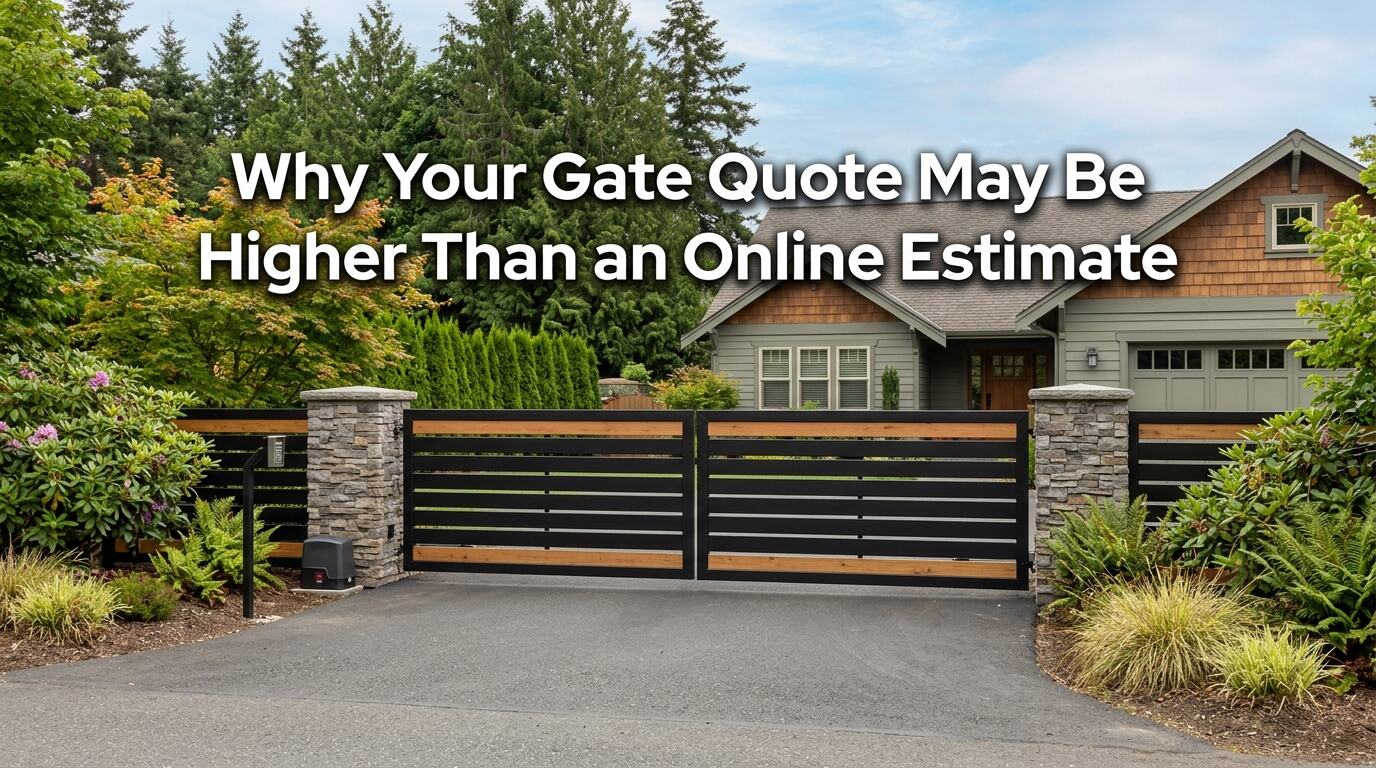
Here’s where the spread really opens up. A simple powder-coated aluminum gate is on the lighter, more affordable end. Ornamental wrought iron, custom welded designs, privacy infill, wood cladding, or a wide dual gate that spans a 20-plus-foot opening all climb from there. Width matters more than people think, a wider opening means a heavier gate, which means a stronger operator, beefier posts, and more material. And if you want something custom, a design that matches your home, your fence line, or your brand on a commercial property, that’s fabrication time, not a catalog SKU. You can see the range of what that looks like in our portfolio of completed gates across the region.
Automation: the motor is just the beginning
“Automatic” means a gate operator, the motor that physically moves the gate, and the operator has to be matched to the gate’s weight, width, and duty cycle. A motor sized for a light residential gate that opens a dozen times a day is a very different unit (and price) than one that has to move a heavy commercial gate hundreds of times a day without burning out. Then there’s the control board, the receiver, remotes, battery backup so the gate still works when the power blinks (and out here, it blinks), and the safety reversing system. A bargain opener kit covers maybe a third of that list. A real gate automation package covers all of it, sized correctly so it lasts. We get deeper into matching operators to gates on our gate automation and access control services page.
Power and the “last hundred feet” problem
This one surprises people more than anything else. Your gate needs power, and the question is how far that power has to travel to reach it. If your electrical panel is at the house and the gate is 300 feet down a rural driveway, common in Skagit and Snohomish County, somebody has to get electricity to the gate. That can mean trenching and conduit the whole way, which is real digging, real material, and sometimes an electrician and a permit. The alternative is a solar power system with a battery bank sized for our gray Northwest winters, which is its own line item. A flat-lot suburban home with power at the curb might spend almost nothing here. A rural property might spend thousands. The online estimate assumes the first scenario every time.
Access control: how people actually get through
A gate that only opens with a remote in your truck is one thing. A gate that needs to let in your family, the mail carrier, a delivery driver, your housekeeper, and the occasional guest, while keeping everyone else out, is another. That’s access control: keypads, card or fob readers, smartphone app entry, and intercoms so you can see and talk to whoever’s at the gate from inside the house or from your phone anywhere. On commercial and multi-family properties it gets more involved still, with managed user lists, telephone entry, and integration with cameras. Every layer you add is capability you wanted, and a line on the quote. An opener kit from a box store includes exactly none of it.
Permits, codes, and the safety equipment that isn’t optional
Automatic gates are governed by safety standards, UL 325 and ASTM F2200, that exist because a powered gate is a heavy machine that moves near people, pets, and cars. Meeting them means photo-eye sensors, safety edges that reverse the gate if it contacts something, proper entrapment-zone protection, and warning signage. These aren’t upsells; they’re the difference between a gate that’s legal and insurable and one that’s a liability waiting to happen. Depending on your jurisdiction and whether you’re running new electrical, there may be permits and inspections too. A reputable quote builds all of this in. A too-cheap one leaves it out and hopes you don’t notice until something goes wrong.
Labor, fabrication, and the cost of doing it once
Finally, there’s the work itself: setting posts in concrete, welding and fabricating, mounting and aligning the gate, running and terminating wiring, programming the system, and testing everything until it’s right. Skilled labor is a real cost, and it’s the cost that protects every other dollar you spent. A gate is one of those things where the cheap install doesn’t just look worse, it fails sooner, sags, binds, and ends up costing you a second project to fix the first. Paying to do it once is almost always cheaper than paying to do it twice.
Pacific Northwest Realities That Move the Number
We mentioned the region earlier, and it deserves its own section, because the conditions we install in around Northwest Washington and the greater Puget Sound region genuinely change what a gate costs, and a national calculator has no idea any of it exists.
Rain, mud, and the wet season
We don’t get a little rain; we get a season of it. That means materials and finishes chosen to resist corrosion, electronics rated and sealed for moisture, footings poured deep enough to stay put in saturated ground, and drainage thought through so water doesn’t pool at the operator. A gate built for Arizona will not have a good life in Sedro-Woolley. Building for the wet costs a bit more up front and saves you from rust, electrical gremlins, and heaving posts down the road. It’s the single biggest reason a gate built for the Northwest is worth more than a gate that just happens to be installed in it.
Long rural driveways and the power that has to reach them
So much of our region is rural or semi-rural, acreage in the Skagit Valley, farms and homesteads across Snohomish County, properties where the house sits well back from the road. That distance is wonderful for privacy and miserable for running power and communication wire to a gate. The further the gate is from your panel, the more trenching, conduit, and wire (or the more solar capacity) the job needs. This is routinely the difference between two otherwise identical gates costing very different amounts, and it’s invisible to anyone pricing from a national table.
Slope, trees, and terrain
Our landscape is beautiful and rarely flat. Sloped driveways change which gate type is even possible. Mature trees and roots affect where posts and trenches can go. Rocky or root-bound ground slows digging. None of these are problems, they’re just conditions, and conditions get priced. The advantage of working with a local crew is that we’ve solved these exact puzzles on properties a few miles from yours, so the solution on your quote is the right one, not a guess. You can see where we work across our Northwest Washington service areas.
Why a Lowball Online Number Can Quietly Cost You More
It’s tempting to chase the cheapest number, and we’d never blame anyone for trying to save money. But on gates specifically, the cheapest quote is often the most expensive one in disguise. Here’s how that plays out.
An undersized operator slapped on a heavy gate works fine in the driveway for the demo, then wears out fast because it’s straining every single cycle. A gate installed without proper safety devices passes the eye test and fails the moment it closes on a bumper or, far worse, a person. Posts set too shallow in our wet ground lean within a year, and a leaning gate binds, drags, and burns out its motor. Skipping the battery backup means your gate traps your car in (or out) every time the power flickers, which, in winter, is often. And the bargain installer who doesn’t pull a permit leaves you holding the problem if an inspector or insurer ever asks.
Every one of those shortcuts turns into a repair call, and gate repairs on a system that was built wrong from the start are frustrating and expensive, you’re often paying to redo work you already paid for once. We see it constantly: the second call is to fix the cheap first job. A complete, correctly sized quote isn’t more expensive because someone’s padding it. It’s more expensive because it includes the parts that keep you from calling for gate repair next spring.
How to Read a Gate Quote Like a Pro
The best way to feel good about a quote, ours or anyone’s, is to understand it well enough to compare quotes fairly. The trick is making sure you’re comparing apples to apples, because two quotes with very different numbers might be pricing very different scopes of work.
Questions worth asking any gate company
- Is the gate operator sized for my gate? Ask what gate weight, width, and duty cycle the motor is rated for. A vague answer is a red flag.
- What safety devices are included? You want to hear photo-eyes, safety edges, and UL 325 compliance, not a blank look.
- How are you getting power to the gate, and is that in the price? Trenching, conduit, and electrical can be a big hidden cost if it’s “not included.”
- Is battery backup part of the package? In our region, it should be.
- What access control comes with it? Keypad, intercom, app entry, make sure the convenience you’re picturing is actually quoted.
- Are permits and any required inspections covered? Find out before, not after.
- What’s the warranty, and who services it? A local company that installs and services its own work is worth a lot when something needs attention.
Red flags in a too-good-to-be-true quote
Be cautious when a number comes in dramatically below everyone else’s. Watch for quotes that don’t mention safety equipment at all, that list “electrical by others” in the fine print, that won’t put the operator’s model or rating in writing, or that can’t tell you who shows up if the gate fails in February. A quote that’s vague about scope isn’t a better deal, it’s the same project with the hard parts left off the page, waiting to reappear as change orders or callbacks.
How Emerald Gate Systems Builds Your Quote
Since we’re asking you to trust the bigger number, it’s only fair to show you how we get to it. We’re locally owned and have been serving Washington since day one, and our whole approach is built around the conditions right here in the Northwest, not a national playbook applied to a place it doesn’t fit.
It starts with an actual look at your property. We talk about what you’re trying to accomplish, security, privacy, curb appeal, keeping delivery trucks from rolling up to the house, managing access for a business or an HOA, and we look at the real conditions: the slope, the soil, the distance to power, the width of the opening, the drainage. From there we spec a gate, an operator sized correctly for it, the access control that matches how you actually live or run your property, the safety equipment the code requires, and the site and electrical work your specific driveway needs. Then we put it in writing, itemized, so you can see exactly what each part is and why it’s there. No mystery, no “trust me,” no surprises halfway through. If you want to see the kind of work that quote turns into, our portfolio is a good place to start, and our story as a local company tells you who’s actually standing behind it.
So What Should You Actually Budget?
People always want a number, so here are honest ballpark ranges, with the firm caveat that the only number that means anything is the one tied to your actual property. Treat these as “which neighborhood am I in,” not “what will mine cost.” For a much more detailed breakdown, our guide to automatic driveway gate cost in Skagit County walks through the factors with real local context.
| Project type | Typical ballpark range* | What pushes it up |
|---|---|---|
| Basic single residential gate, power nearby | $4,000 to $8,000 | Custom design, wider opening, slope |
| Dual-swing or slide gate, automated, with access control | $8,000 to $16,000 | Long power run, solar, intercom/cameras |
| Rural property, long driveway, solar & smart access | $12,000 to $25,000+ | Trenching distance, terrain, premium materials |
| Commercial / multi-family / HOA systems | Varies widely | Traffic volume, managed access, integration |
If those ranges feel higher than the internet promised, you now know exactly why, you’re looking at the price of a finished, working, code-compliant gate built for where you live, not a panel on a pallet.
Get a Real Number for Your Property
The honest truth is that no article and no online calculator can tell you what your gate will cost, only a look at your actual driveway can. The good news is that finding out is free and there’s no pressure attached. We’ll come out, look at your property, talk through what you want, and give you a clear, itemized quote you can understand, so the number you get is the number, not a teaser that grows later.
Call (360) 657-9975 or Schedule a Free Consultation Call. We’re locally owned, we know the Northwest, and we’ve been serving Washington property owners since day one, from Sedro-Woolley and the Skagit Valley across the greater Puget Sound region.
For the bigger picture, our complete guide to automatic gate installation in Northwest Washington walks through planning, permits, power, and the full installation process.
Frequently Asked Questions About Gate Quotes and Estimates
Why is my gate quote so much higher than the price I found online?
Because the online price is usually for a single part, a gate panel or a DIY opener kit, while your quote covers the entire installed project: the gate, the correctly sized automation, the electrical to power it, access control, code-required safety equipment, site prep, and skilled labor. The online number answers “what does a gate part cost?” Your quote answers “what does my working gate, installed at my home in Washington, cost?”
Are online gate cost estimates ever accurate?
They’re accurate for what they measure, which is usually a national average for hardware. They’re just not measuring your project. They don’t know your slope, soil, the distance to power, the gate size you need, your access control, or local code requirements, all of which can swing the real cost by thousands. Use them to get oriented, not to budget.
What’s the difference between an estimate and a quote?
An estimate is a rough, non-binding guess, often made without seeing your property. A quote is a specific, itemized price based on your actual site and the exact scope of work. A good quote should list what’s included so there are no surprises. If a “quote” is just one round number with no detail, treat it as an estimate.
Why does a site visit change the price?
Because the things that drive cost the most, slope, soil, drainage, opening width, and how far power has to travel, can only be seen in person. A driveway that looks simple in a photo can hide a 250-foot power run or ground that needs deeper footings. The site visit is what turns a guess into a real, reliable number.
What makes gates cost more in the Pacific Northwest?
Our wet climate calls for corrosion-resistant materials, sealed electronics, and deeper footings in saturated soil. Our long rural driveways in Skagit and Snohomish County often mean significant trenching or solar power to reach the gate. And our slope and terrain affect which gate types and footings are needed. These regional realities don’t appear in national pricing but absolutely appear in the field.
Why is getting power to the gate sometimes so expensive?
If your electrical panel is far from the gate, common on rural Northwest properties, someone has to physically get power there, which means trenching, conduit, and wiring across that distance, sometimes with an electrician and permit. The alternative is a solar system sized for our gray winters. Either way, it’s a real line item the online estimate never includes because it assumes power is right at the gate.
Is the cheapest gate quote a good deal?
Not usually. A dramatically low quote often leaves out safety equipment, undersizes the operator, skips battery backup, sets posts too shallow, or excludes the electrical work, all of which lead to early failures and repair bills. Paying to do the job right once is almost always cheaper than paying to fix a cut-rate install later.
What safety equipment should be included in a gate quote?
At minimum, a compliant automatic gate includes photo-eye sensors, safety edges that reverse the gate on contact, proper entrapment-zone protection, and warning signage, all meeting UL 325 and ASTM F2200 standards. These protect people, pets, and vehicles and aren’t optional extras. If a quote doesn’t mention them, ask why.
Does access control add a lot to the cost?
It depends on what you want. A simple keypad is modest; video intercoms, smartphone app entry, card or fob readers, and managed user systems for businesses or HOAs add more. The key is matching the access control to how you actually use the property so you’re paying for convenience you’ll use, not features you won’t.
How long does a custom gate installation take?
It varies with the design and site work. A straightforward residential gate can be relatively quick once materials are ready, while custom fabrication, long power runs, or solar setups add time. We’ll give you a realistic timeline with your quote so you know what to expect from start to finish.
Do you offer free quotes in Northwest Washington?
Yes. We provide free, no-pressure consultations and itemized quotes across Northwest Washington and the greater Puget Sound region, including Sedro-Woolley, the Skagit Valley, and Snohomish County. Call (360) 657-9975 or schedule a free consultation to get a real number for your property.
Will my quote change after I accept it?
A proper quote based on a real site visit shouldn’t move unless you change the scope or we uncover something genuinely hidden underground. That’s the whole point of itemizing it up front. Vague quotes are the ones that “grow”, which is exactly why we put everything in writing before any work begins.