
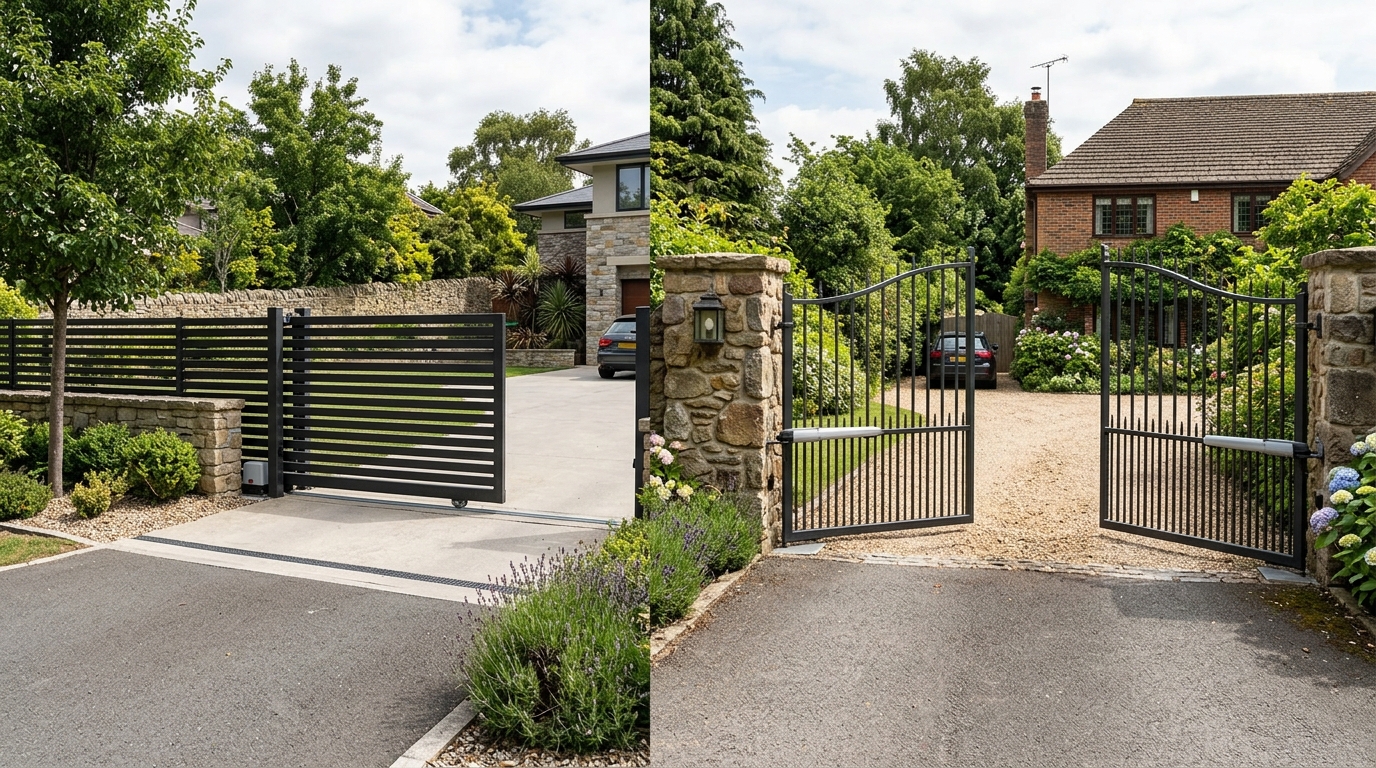
Compare space, slope, cost, security, and maintenance factors before choosing a sliding gate or swing gate system.
Choosing between a sliding gate and a swing gate sounds simple until you start looking at the real details of your property. How much room does the gate have to open? Is the driveway flat or sloped? Is the entrance close to the road? Will the gate be used a few times a day or all day long? Do you need access control, cameras, intercoms, remotes, keypads, or commercial-grade security? And because this is Washington State, how will rain, gravel, wind, soft ground, and seasonal debris affect the system?
Those questions matter. A swing gate can look beautiful at a residential driveway or rural entrance. A sliding gate can be the smarter choice for tighter spaces, commercial sites, and sloped entrances. Both can be automated. Both can be custom-built. Both can work well when they are designed correctly. But the wrong gate style in the wrong location can lead to frustration, repair calls, and unnecessary costs.
Emerald Gate Systems designs, fabricates, installs, automates, and services custom gate systems across Northwest Washington State, Sedro-Woolley, Skagit County, Whatcom County, Snohomish County, island communities, and the greater Puget Sound region. As a locally owned company serving Washington State since day one, Emerald builds gate systems for Pacific Northwest conditions, not generic layouts.
This guide breaks down sliding gate vs swing gate installation Washington State so you can choose the better option for your home, farm, HOA, commercial property, or managed site.
Quick Answer: Is a Sliding Gate or Swing Gate Better?
A sliding gate is usually better for tight spaces, sloped driveways, commercial properties, high-security entrances, and driveways close to the road.
A swing gate is usually better for residential driveways, rural properties, estate entrances, and locations with enough open space for the gate to swing inward or outward.
The best choice depends on your driveway layout, available space, slope, gate size, daily use, security needs, automation plan, and long-term maintenance expectations.
What Is a Sliding Gate?
A sliding gate moves sideways across the entrance. Instead of opening inward or outward, it travels along the fence line or property boundary. Sliding gates are common for commercial properties, storage yards, apartment communities, industrial entrances, parking lots, schools, farms, and driveways where there is not enough room for a swing gate.
A sliding gate can be manual, but many property owners choose automatic sliding gate installation for convenience and security. With the right operator, a sliding gate can open using a keypad, remote, card reader, intercom, phone entry system, RFID reader, camera system, or access control panel.
Common Sliding Gate Types
Tracked sliding gates move along a track installed across the entrance. These can work well in some locations, but the track must stay clear of rocks, leaves, mud, ice, and debris.
Cantilever sliding gates are supported by posts and rollers, so the gate does not rely on a ground track across the driveway. This can be a strong choice for Washington State properties with gravel, rain, mud, or uneven ground.
Custom sliding gates are fabricated to fit the property’s exact opening, security needs, design style, and automation requirements.
What Is a Swing Gate?
A swing gate opens like a door. It can swing inward or outward depending on the property layout, though inward swing is often preferred when there is enough room. Swing gates can be single-leaf or double-leaf. A single swing gate uses one gate panel. A double swing gate uses two panels that meet in the middle.
Swing gates are popular for residential driveways, custom homes, farms, private roads, estate entrances, and properties where curb appeal matters. They can be simple, decorative, modern, rustic, ornamental, or fully custom.
Like sliding gates, swing gates can be manual or automatic. Automatic swing gates can be operated with remotes, keypads, intercoms, sensors, phone entry systems, or smart access control.
Sliding Gate vs. Swing Gate: Main Difference
The main difference is how the gate opens. A sliding gate moves sideways. A swing gate opens inward or outward. That one difference affects almost everything else: space, slope, cost, security, maintenance, automation, installation complexity, and long-term performance.
A sliding gate needs side room. A swing gate needs open swing space. A sliding gate is often better for tight or sloped entrances. A swing gate often gives a more traditional look when the driveway has enough room.
Space Requirements: Which Gate Needs More Room?
Space is one of the biggest factors when choosing between a sliding gate and a swing gate.
Sliding Gate Space Requirements
A sliding gate needs enough room to slide open along one side of the entrance. If your driveway opening is 16 feet wide, the gate needs enough clear side space to move completely out of the opening. This makes sliding gates a good choice when the driveway itself is short or when vehicles need to pull in safely off the road while the gate opens. However, the side area must be clear. Trees, landscaping, fences, walls, slopes, buildings, or other obstructions can limit where the gate can travel.
Swing Gate Space Requirements
A swing gate needs clear space in the direction it opens. For a driveway gate, that usually means enough room inside the property for the gate leaf or leaves to swing without hitting vehicles, slopes, trees, fencing, or structures. If the driveway is short, a swing gate can create problems because vehicles may have to wait too close to the road while the gate opens. This is especially important on busy roads, shared access roads, rural highways, or commercial entrances.
Best Choice for Space
Choose a sliding gate if the entrance is tight, close to the road, or does not have enough depth for a gate to swing. Choose a swing gate if the driveway has plenty of open space and the gate can swing safely without blocking traffic or hitting obstacles.
Driveway Slope: Which Gate Works Better on Hills?
Washington State properties are not always flat. Many driveways in Skagit County, Whatcom County, Snohomish County, island communities, and the Puget Sound region have slopes, curves, uneven ground, or gravel transitions. Slope can make a big difference.
Sliding Gates on Sloped Driveways
Sliding gates often work better on sloped entrances because they move sideways rather than swinging across an incline. If the ground allows for a proper sliding path, a sliding gate can be a practical solution for driveways where a swing gate would drag or require special fabrication. Cantilever sliding gates can be especially useful when ground conditions are uneven or when a track would be difficult to keep clean.
Swing Gates on Sloped Driveways
Swing gates can be more challenging on sloped driveways. If the gate swings uphill, it may hit the ground. If it swings downhill, it may create safety or operator strain issues. Some swing gates can be built to handle mild slopes, but steep grades need careful planning. A swing gate may still work on a sloped property, but it should be evaluated before installation.
Best Choice for Slope
Choose a sliding gate for most sloped or uneven entrances. Choose a swing gate only if the driveway has enough flat area for the gate to open properly.
Security: Which Gate Is More Secure?
Both sliding gates and swing gates can improve security, especially when paired with access control, cameras, intercoms, and automatic operators. The better security choice depends on the property.
Sliding Gate Security
Sliding gates are often preferred for commercial and high-security applications because they can be built heavy-duty and are harder to force open when properly installed. They are commonly used for:
- Commercial yards
- Warehouses
- Storage facilities
- Industrial properties
- Apartment communities
- Parking areas
- Schools
- Utility sites
- Managed properties
A sliding gate can create a strong controlled entry point, especially when integrated with card readers, keypads, vehicle loops, cameras, and access control systems.
Swing Gate Security
Swing gates can also be secure, especially when built with strong materials, proper hinges, quality operators, and secure locking systems. For residential properties, farms, and private driveways, a swing gate can provide a strong privacy and security upgrade. It also creates a clear visual boundary at the entrance.
Best Choice for Security
Choose a sliding gate for commercial security, higher traffic, tight access points, or properties where forced entry resistance matters more. Choose a swing gate for residential privacy, estate entrances, rural properties, and locations where appearance and controlled access are both important.
Cost: Is a Sliding Gate or Swing Gate More Expensive?
Cost depends on gate size, material, automation, access control, site conditions, and installation complexity. In many cases, swing gates can be more cost-effective for simple residential installations. Sliding gates may cost more because they often require more hardware, side clearance planning, rollers, track or cantilever systems, and heavier-duty operators.
However, the cheaper option is not always the better option. A swing gate installed in the wrong location can become expensive later if it drags, strains the operator, blocks traffic, or needs repeated adjustment. A sliding gate may cost more upfront but be the better long-term choice for a sloped or tight entrance.
Sliding Gate Cost Factors
- Gate width and weight
- Track or cantilever design
- Side clearance preparation
- Ground conditions
- Gate operator size
- Access control equipment
- Concrete and post requirements
- Commercial-grade hardware
- Safety devices
- Electrical work
Swing Gate Cost Factors
- Single or double gate design
- Gate material and style
- Post and hinge requirements
- Operator type
- Driveway slope
- Wind exposure
- Custom fabrication
- Access control equipment
- Safety sensors
- Electrical work
Best Choice for Budget
Choose a swing gate if the layout is simple, the driveway is flat, and the property has enough swing room. Choose a sliding gate if the site conditions make a swing gate difficult, even if the upfront cost is higher.
Maintenance: Which Gate Is Easier to Maintain?
Both gate types need maintenance, especially when they are automated. Washington State weather can be tough on gates. Rain, moisture, gravel, leaves, wind, soft ground, and seasonal debris can affect moving parts, sensors, wiring, hinges, rollers, and operators.
Sliding Gate Maintenance
Sliding gates need attention to rollers, tracks, chains, belts, operators, guide rollers, and alignment. If the gate uses a ground track, the track must stay clear of rocks, mud, leaves, ice, and debris. Cantilever gates can reduce some track-related maintenance because they do not use a ground track across the entrance.
Common sliding gate maintenance includes:
- Checking rollers
- Clearing debris
- Inspecting chains or belts
- Testing the operator
- Checking gate alignment
- Inspecting safety sensors
- Looking for wear on moving parts
- Testing access control devices
Swing Gate Maintenance
Swing gates need attention to hinges, posts, arms, operators, alignment, and wind-related stress. A sagging swing gate can put strain on the operator and cause the system to work harder than it should. Common swing gate maintenance includes:
- Inspecting hinges
- Checking post stability
- Testing operator arms
- Adjusting alignment
- Lubricating moving parts where appropriate
- Testing safety sensors
- Checking access controls
- Watching for sagging or dragging
Best Choice for Maintenance
Choose a cantilever sliding gate if the entrance deals with gravel, mud, leaves, or debris and you want to avoid a ground track. Choose a swing gate if the driveway is flat, the gate is not too large, and the hardware can be maintained easily.
Wind and Weather: What Works Best in the Pacific Northwest?
Washington State weather should be part of the gate decision from the beginning. A gate system in Northwest Washington State may deal with rain, wind, moss, tree debris, soft soil, coastal moisture, gravel driveways, and long damp seasons.
Sliding Gates in Weather
Sliding gates can perform well in wet and windy conditions, especially if designed correctly. Because they move sideways, they are often less affected by wind than large swing gates. A cantilever sliding gate can be a strong choice when ground conditions are wet, uneven, or debris-heavy.
Swing Gates in Weather
Swing gates can work very well in Washington State, but wind exposure matters. A large solid swing gate can catch wind like a sail. That can put extra pressure on the operator, hinges, and posts. For exposed locations, a swing gate may need a more open design, stronger hardware, and the right operator.
Best Choice for Weather
Choose a sliding gate for exposed, windy, commercial, or debris-prone entrances. Choose a swing gate when the property is protected, the gate design allows airflow, and the entrance has proper swing clearance.
Appearance: Which Gate Looks Better?
This depends on personal taste and property style.
Swing Gate Appearance
Swing gates are often chosen for curb appeal. They create a classic entrance and work well for homes, farms, estates, and private properties. They can look elegant, traditional, rustic, modern, or decorative. Double swing gates can make a driveway entrance feel more finished and welcoming.
Sliding Gate Appearance
Sliding gates can also look clean and attractive, especially when custom fabricated. They are often more practical-looking but can still be designed to match the property. For commercial properties, a sliding gate often looks secure and professional. For residential properties, a custom sliding gate can be built to blend with fencing, landscaping, and architecture.
Best Choice for Appearance
Choose a swing gate if you want a classic driveway entrance with strong curb appeal. Choose a custom sliding gate if you want a clean, space-saving design that still looks polished.
Automation: Can Both Sliding and Swing Gates Be Automatic?
Yes. Both sliding gates and swing gates can be automated. Automatic gate installation usually includes a gate operator, safety devices, access control equipment, and power planning.
Sliding Gate Automation
Sliding gate operators move the gate sideways using a motorized system. They are common for commercial gates, high-use entrances, apartment communities, storage yards, and properties with limited space. Sliding gate automation may include:
- Keypads
- Remote controls
- Card readers
- RFID access
- Phone entry systems
- Vehicle detection loops
- Camera integration
- Safety sensors
- Battery backup
Swing Gate Automation
Swing gate operators open and close the gate leaf or leaves. They are common for residential driveways, farms, estate entrances, and private roads. Swing gate automation may include:
- Remote controls
- Keypad entry
- Intercoms
- Video entry
- Safety sensors
- Vehicle detection
- Battery backup
- Smart access controls
Best Choice for Automation
Choose a sliding automatic gate for commercial use, tight spaces, heavy gates, and high traffic. Choose an automatic swing gate for residential driveways, farms, and properties where the gate has room to open.
Access Control Options for Sliding and Swing Gates
Access control is what makes a gate system more useful. It decides who can enter, how they enter, and when they are allowed access. Common access control options include:
- Keypad entry
- Remote transmitters
- Phone entry systems
- Video intercoms
- Card readers
- Badge access
- RFID readers
- Mobile access
- Vehicle detection loops
- Security camera integration
For homes, a simple keypad and remote setup may be enough. For HOAs, apartments, and commercial properties, access control may need to support residents, employees, vendors, guests, deliveries, and emergency responders. Learn more about access control systems for automatic gates in Washington State.
Residential Properties: Sliding Gate or Swing Gate?
For most residential properties, swing gates are popular because they look good and create a strong entrance. But sliding gates can be the better option when the driveway is short, sloped, or close to the road.
Choose a Residential Swing Gate If:
- You want a classic driveway entrance
- Your driveway has enough room
- The entrance is mostly flat
- You want a decorative or custom design
- The gate will not block traffic while opening
- You prefer a traditional look
Choose a Residential Sliding Gate If:
- Your driveway is short
- Your entrance is close to the road
- Your driveway is sloped
- You have limited swing room
- You want a more secure barrier
- Wind exposure is a concern
For homes in Sedro-Woolley, Skagit County, Whatcom County, Snohomish County, and the Puget Sound region, the right choice often comes down to driveway shape and daily convenience.
Farm and Rural Properties: Sliding Gate or Swing Gate?
Farm and rural properties need gates that are practical, durable, and easy to use. Swing gates can work well for wide rural entrances when there is enough open space. Sliding gates can work better when equipment traffic, slope, security, or access control are bigger concerns.
Choose a Farm Swing Gate If:
- The entrance is wide and open
- The ground is fairly level
- You need a simple, strong gate
- Large equipment has room to turn
- The gate does not need heavy daily automation
Choose a Farm Sliding Gate If:
- The entrance is sloped or uneven
- The property needs stronger access control
- The gate will be automated
- Trucks and trailers need clear entry
- You want a controlled commercial-style entrance
For rural Washington State properties, durability matters more than decoration. The gate needs to work in rain, gravel, mud, and real daily use.
Commercial Properties: Sliding Gate or Swing Gate?
For commercial properties, sliding gates are often the better choice. They are space-efficient, strong, and well-suited for frequent use. They also work well with access control systems, cameras, card readers, vehicle loops, and commercial-grade operators.
Choose a Commercial Sliding Gate If:
- The gate will be used often
- Security is a priority
- The entrance is tight
- The site has employee or vendor access
- The property has commercial vehicles
- You need card readers or access control
- You want a heavy-duty automated gate
Choose a Commercial Swing Gate If:
- The entrance has plenty of open space
- Traffic volume is lower
- The gate is mainly for after-hours security
- The property layout supports safe swing movement
- A swing design fits the site better
Commercial gates should be selected based on use, not just appearance. A gate that opens beautifully twice a day may not be the right system for a business entrance that cycles all day.
HOA and Managed Properties: Sliding Gate or Swing Gate?
For HOAs, apartment communities, condos, and managed properties, reliability is the priority. Residents need easy access. Visitors need a simple entry process. Vendors and deliveries need controlled access. Property managers need a system that can be updated when residents move in or out.
Sliding gates are often preferred for managed properties because they handle traffic well and use space efficiently. Swing gates may work for smaller communities or properties with more room.
Best Features for Managed Property Gates
- Phone entry systems
- Directory-based access
- Keypad entry
- RFID access
- Card readers
- Remote transmitters
- Camera systems
- Vehicle detection loops
- Emergency access planning
- Preventive maintenance
Learn more about automatic gate installation and repair for managed properties in Washington State.
Repair and Maintenance Considerations
Every gate system needs service over time. Sliding gates and swing gates both have moving parts, hardware, operators, sensors, access control devices, and electrical components. Preventive maintenance helps keep the system reliable and reduces emergency repairs.
Common Sliding Gate Repair Issues
- Worn rollers
- Track problems
- Chain or belt issues
- Gate alignment problems
- Debris blocking movement
- Operator strain
- Sensor problems
- Access control failure
Common Swing Gate Repair Issues
- Worn hinges
- Sagging gate panels
- Post movement
- Operator arm issues
- Wind strain
- Gate dragging
- Sensor misalignment
- Keypad or remote problems
Why Maintenance Matters
A gate that is slightly out of alignment today can become a broken gate later. A noisy operator can turn into a failed motor. A sensor problem can leave the gate stuck open or stuck closed. Regular maintenance is especially important for commercial gates, HOA gates, apartment gates, farm gates, and high-use residential gates.
Sliding Gate vs. Swing Gate Comparison
| Factor | Sliding Gate | Swing Gate |
|---|---|---|
| Best For | Tight spaces, slopes, commercial sites, high-security entrances | Residential driveways, farms, estates, classic entrances |
| Space Needed | Side room along the fence line | Open space for the gate to swing |
| Slope Performance | Usually better for sloped driveways | Better for flat entrances |
| Security | Strong choice for commercial and controlled access | Good for homes, farms, and private entrances |
| Appearance | Clean, practical, custom options available | Classic, decorative, strong curb appeal |
| Automation | Excellent for high-use and commercial systems | Excellent for residential and rural systems |
| Maintenance | Track/roller/chain or cantilever maintenance | Hinge/post/operator arm maintenance |
| Weather Considerations | Good for wind and tight spaces; cantilever helps with debris | Works well when wind and swing clearance are planned |
| Typical Use | Commercial gates, parking gates, apartment gates, tight driveways | Residential gates, farm gates, estate gates, private driveways |
Common Mistakes to Avoid When Choosing a Gate
Choosing Based on Looks Alone
A gate can look great and still be wrong for the entrance. Layout, slope, traffic, and automation needs should come first.
Ignoring Driveway Slope
Slope can make or break the gate design. Always evaluate grade before choosing a swing gate.
Forgetting About Vehicle Waiting Space
If the gate is close to the road, vehicles need room to wait safely while the gate opens.
Choosing the Wrong Operator
The gate operator must match the gate size, weight, and daily use. Undersized operators wear out faster.
Not Planning for Access Control
Visitors, vendors, residents, employees, deliveries, and emergency responders all need to be considered.
Skipping Maintenance Planning
A gate is a mechanical system. It needs maintenance to stay reliable.
How to Choose the Right Gate for Your Washington State Property
Before choosing a sliding gate or swing gate, ask these questions:
- Is the property residential, commercial, agricultural, or managed?
- How often will the gate open each day?
- Is the driveway flat or sloped?
- Is the entrance close to the road?
- Is there room for a gate to swing?
- Is there room for a gate to slide?
- Will the gate be manual or automatic?
- Do you need keypads, cameras, intercoms, or card readers?
- Does the property get heavy wind or debris?
- Will trucks, trailers, or emergency vehicles need access?
- Is long-term maintenance part of the plan?
The right gate is the one that fits the property, works with the weather, supports daily access, and can be maintained properly.
Why Local Gate Installation Experience Matters
Gate installation in Washington State is not the same as gate installation in a dry, flat climate. Northwest Washington State properties often deal with rain, soft ground, gravel driveways, tree debris, wind, long rural lanes, island communities, coastal moisture, and commercial traffic. These details affect gate design, operator selection, access control placement, wiring, post setting, and maintenance needs.
Emerald Gate Systems is locally owned and serving Washington State since day one. The team works with homeowners, farms, HOAs, property managers, commercial sites, institutional properties, and managed communities across Sedro-Woolley, Skagit County, Whatcom County, Snohomish County, island communities, and the greater Puget Sound region. That local experience helps property owners avoid the most common gate mistakes and choose a system built for real Pacific Northwest conditions.
Work With Emerald Gate Systems
If you are deciding between a sliding gate and a swing gate, Emerald Gate Systems can help you choose the right system for your property.
We design, fabricate, install, automate, repair, and maintain sliding gates, swing gates, electric gates, custom gates, commercial gates, residential driveway gates, farm gates, HOA gate systems, access control systems, intercoms, cameras, sensors, bollards, ADA-compliant entry solutions, emergency repair systems, and preventive maintenance plans.
The best gate starts with the right layout, the right equipment, and a clear understanding of how the property is used.
Call (360) 657-9975 or schedule a free consultation call with Emerald Gate Systems today.
Emerald Gate Systems proudly serves Northwest Washington State, Sedro-Woolley, Skagit County, Whatcom County, Snohomish County, island communities, and the greater Puget Sound region with gate systems built for Pacific Northwest conditions.
For the bigger picture, our complete guide to automatic gate installation in Northwest Washington walks through planning, permits, power, and the full installation process.
FAQ: Sliding Gate vs. Swing Gate Installation in Washington State
Is a sliding gate better than a swing gate?
A sliding gate is better for tight spaces, sloped driveways, commercial properties, high-security entrances, and driveways close to the road. A swing gate is better for residential driveways, farms, estates, and properties with enough room for the gate to open.
Is a swing gate cheaper than a sliding gate?
In many cases, a swing gate can be less expensive for a simple residential driveway with flat ground and enough space. Sliding gates may cost more because they need side clearance, rollers, track or cantilever hardware, and sometimes heavier-duty operators.
Which gate is better for a sloped driveway?
A sliding gate is usually better for a sloped driveway because it moves sideways instead of swinging across the slope. Swing gates can work on some mild slopes, but steep driveways require careful planning.
Which gate is better for a commercial property?
A sliding gate is often better for commercial properties because it is strong, space-efficient, and works well with frequent use, access control, cameras, vehicle loops, and commercial-grade operators.
Which gate is better for a residential driveway?
A swing gate is often preferred for residential driveways because it offers a classic look and strong curb appeal. However, a sliding gate may be better if the driveway is short, sloped, tight, or close to the road.
Can both sliding gates and swing gates be automatic?
Yes. Both sliding gates and swing gates can be automated with gate operators, keypads, remotes, intercoms, cameras, access control systems, safety sensors, and vehicle detection loops.
What is a cantilever gate?
A cantilever gate is a type of sliding gate that is supported by posts and rollers instead of riding on a ground track across the driveway. It is often a good choice for gravel, mud, rain, debris, commercial sites, and rural Washington State properties.
Do sliding gates need more maintenance than swing gates?
Sliding gates and swing gates both need maintenance. Sliding gates may need roller, track, chain, and alignment service. Swing gates may need hinge, post, arm, and alignment service. The best maintenance schedule depends on use and site conditions.
Which gate works better in Washington State weather?
Both can work well when installed properly. Sliding gates, especially cantilever gates, can be better for debris-prone or windy areas. Swing gates can work well when the entrance is protected, flat, and has enough room.
Can a swing gate handle wind?
A swing gate can handle wind if it is designed correctly. Large solid swing gates can catch wind, so exposed areas may need stronger posts, proper operator sizing, and a gate design that allows airflow.
How do I know if I have enough room for a swing gate?
You need enough clear space for the gate to open fully without hitting vehicles, slopes, landscaping, fences, or structures. Vehicles should also have room to wait safely while the gate opens.
How do I know if I have enough room for a sliding gate?
You need enough clear side space for the gate to slide completely open. The side area must be free from major obstructions such as buildings, trees, steep slopes, or fencing conflicts.
Can I add access control to either gate type?
Yes. Sliding gates and swing gates can both use keypads, remotes, phone entry systems, video intercoms, card readers, RFID systems, mobile access, cameras, and vehicle detection loops.
Should I repair my existing gate or replace it?
Repair may make sense if the gate is structurally sound and the operator or hardware can be fixed. Replacement may be better if the gate is damaged, unsafe, outdated, poorly aligned, or no longer fits the property access needs.
Who installs sliding gates and swing gates in Washington State?
Emerald Gate Systems installs, automates, repairs, and maintains sliding gates, swing gates, custom gates, electric gates, access control systems, intercoms, cameras, sensors, and commercial gate systems across Washington State, with a strong focus on Northwest Washington State, Sedro-Woolley, Skagit County, Whatcom County, Snohomish County, island communities, and the greater Puget Sound region.
How do I schedule a gate consultation?
Call (360) 657-9975 or schedule a free consultation call with Emerald Gate Systems to compare sliding gate and swing gate options for your Washington State property.